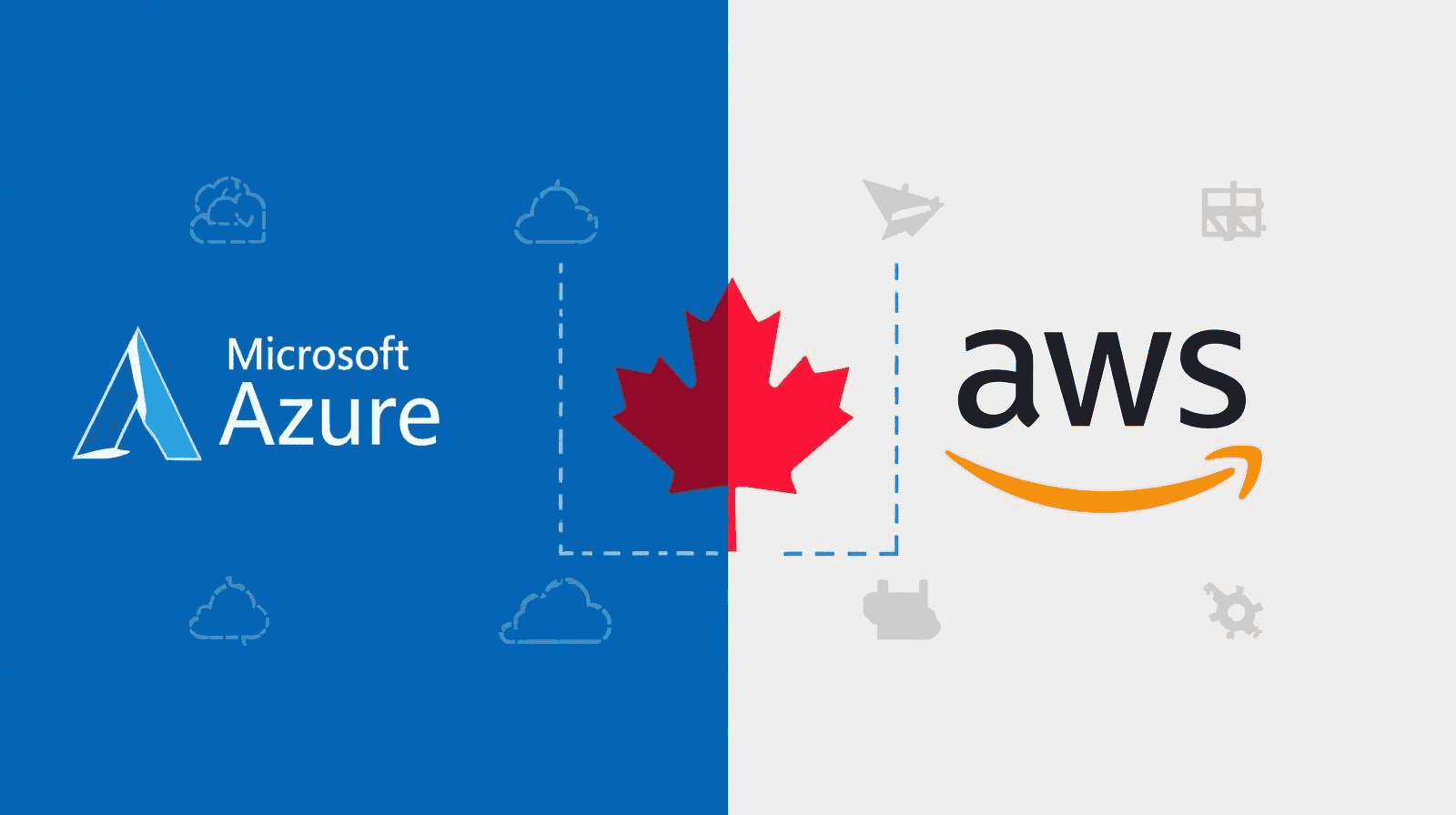
Azure vs AWS for Canadian Small Businesses — A Real Comparison from an MSP
For most Canadian small businesses, Microsoft Azure is the better default cloud platform — it integrates seamlessly with Microsoft 365, offers Canadian data residency in Toronto and Quebec City, and simplifies PIPEDA compliance. AWS is the stronger choice for developer-driven teams needing raw infrastructure flexibility. Both platforms have Canadian regions, competitive pricing, and enterprise-grade security. Your right choice depends on your existing tools, team size, and compliance obligations. An MSP can eliminate the guesswork.
If you’ve been tasked with moving your business to the cloud — or you’re evaluating your current setup — you’ve almost certainly landed on the same two names: Microsoft Azure and Amazon Web Services (AWS). Together, they command roughly 55% of the global cloud infrastructure market (Synergy Research Group, 2024).
But here’s what most comparison articles won’t tell you: the “best” platform isn’t universal. As a managed service provider (MSP) working with Canadian SMBs every day, we’ve seen businesses overpay, misconfigure, and even face compliance headaches — simply because they chose based on brand recognition instead of fit.
This guide breaks down the real differences — cloud pricing models, Canadian data sovereignty, security compliance, support quality, and scalability — so you can make an informed decision.
Canadian Cloud Adoption Stat
73%
of Canadian SMBs now use at least one cloud-based service, up from 58% in 2021.
Source: Statistics Canada, Digital Economy Survey, 2023
Why the Canadian Context Changes Everything
Cloud platform decisions in Canada aren’t just about performance benchmarks. Data residency, PIPEDA compliance (Canada’s federal private sector privacy law), and provincial privacy regulations like Quebec’s Law 25 add a layer of complexity that most generic comparisons skip entirely.
Both Azure and AWS operate Canadian regions — but there are meaningful differences in how they handle data sovereignty, compliance certifications, and support for regulated industries like healthcare, legal, and financial services.
⚠️ Important: Storing customer data on US-based servers without proper data processing agreements may expose Canadian businesses to PIPEDA violations and potential fines. Always confirm your cloud provider’s Canadian data residency options before migrating.
Azure vs AWS: Side-by-Side for Canadian SMBs
| Category | Microsoft Azure | Amazon AWS |
|---|---|---|
| Canadian Regions | Toronto & Quebec City | Montreal & Calgary |
| PIPEDA Compliance Tools | ✅ Strong (built-in compliance centre) | ✅ Available (manual configuration) |
| Microsoft 365 Integration | ✅ Native, seamless | ⚠️ Requires third-party connectors |
| Pricing Model | Consumption + licence bundles | Consumption-based (pay-as-you-go) |
| Free Tier | 12-month + always-free services | 12-month + always-free services |
| Support for SMBs | Developer/Standard/Premier tiers | Basic/Developer/Business tiers |
| Best For | Microsoft-centric teams, regulated industries | Developer teams, custom infrastructure |
| MSP Partner Ecosystem (Canada) | ✅ Extensive CSP network | ✅ Strong APN partner network |
Microsoft Azure: The Case for Canadian SMBs
If your business already runs on Microsoft 365 — Outlook, Teams, SharePoint, OneDrive — Azure isn’t just a cloud platform. It’s a natural extension of your existing ecosystem. Azure Active Directory (now Entra ID), single sign-on, and conditional access policies integrate without third-party glue.
Azure’s Canadian data centres in Toronto and Quebec City give businesses operating under PIPEDA and Quebec Law 25 a clear, auditable path to compliance. Microsoft’s Compliance Manager dashboard provides real-time compliance scores and actionable improvement recommendations — a feature that genuinely simplifies audits for SMBs without dedicated legal teams.
From a cost perspective, Microsoft’s Azure Hybrid Benefit lets businesses repurpose existing Windows Server licences in the cloud, reducing infrastructure costs by up to 40% according to Microsoft’s own modelling. For SMBs already paying for Microsoft licensing, this is real money.
📊 Industry Data: Microsoft Azure holds approximately 21% of the global cloud market share as of Q4 2024, making it the second-largest cloud provider behind AWS (31%). However, in enterprise and hybrid cloud deployments, Azure leads in several key verticals including government and financial services. — Statista, 2024
Amazon AWS: When It’s the Right Call
AWS has the broadest service catalogue in cloud computing — over 200 fully featured services as of 2024. For businesses building custom applications, running containerized workloads, or needing cutting-edge machine learning infrastructure, AWS’s depth is difficult to match.
AWS’s Canada (Central) region in Montreal and the newer Canada West region in Calgary provide solid Canadian data residency options. The AWS Artifact compliance portal provides on-demand access to security and compliance reports, which is useful for regulated industries.
The honest downside for most Canadian SMBs: AWS’s breadth can become a liability. Without specialized cloud expertise, teams often over-provision, under-optimize, and face “bill shock” — unexpected charges from data egress fees, idle resources, or misconfigured storage. A qualified MSP partner mitigates this significantly.
Managed Cloud Services
Not Sure Which Platform Fits Your Business?
Our Canadian MSP team assesses your infrastructure, compliance requirements, and budget — then recommends the right cloud fit. No jargon. No vendor bias.
How to Actually Decide: A Practical Framework
After assessing dozens of Canadian SMB cloud migrations, here’s the honest framework we use internally:
Choose Azure if: You run Microsoft 365, you work in healthcare/legal/finance, you need strong compliance tooling out of the box, or you want a single-vendor approach for licensing and cloud.
Choose AWS if: You have an in-house development team, you’re building custom SaaS products, you need specialized ML/AI services (SageMaker, Bedrock), or your existing stack is AWS-native.
Consider both (multi-cloud) if: You have distinct workloads with different requirements, you want to avoid single-vendor lock-in, or you’re in a regulated industry with complex redundancy requirements.
IT Strategy & Consulting
Get a Free Cloud Readiness Assessment
Our Canadian IT consultants review your current infrastructure and map a cloud migration path that’s cost-efficient, secure, and compliant with Canadian privacy law.
Understanding PIPEDA in the Cloud Age
Canada’s Personal Information Protection and Electronic Documents Act (PIPEDA) governs how private-sector organizations collect, use, and disclose personal information. As cloud environments become more complex, understanding where your data physically resides — and how it’s protected — is non-negotiable. The Office of the Privacy Commissioner of Canada provides detailed guidance on cloud computing and PIPEDA obligations — required reading for any Canadian business planning a cloud migration.
Frequently Asked Questions
The Bottom Line
There’s no universally “correct” answer in the Azure vs AWS debate — but there is usually a clear answer for your specific business. For the majority of Canadian SMBs running Microsoft-centric environments and navigating Canadian privacy law, Azure delivers a more cohesive, compliance-ready, and cost-manageable path. For developer-driven teams building custom infrastructure, AWS remains the more powerful raw engine.
The real mistake isn’t choosing the “wrong” platform — it’s choosing without guidance, then discovering that mistake six months and several thousand dollars later. Working with a Canadian MSP gives you a partner who’s been through this decision many times, understands the local regulatory landscape, and can hold vendors accountable on your behalf.